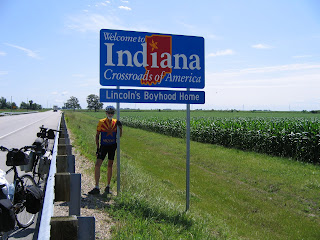
Thursday, March 26, 2009

Cross-country bike trip (cont.)


M

July 9. Summer in the Midwest...with geezer, splendidly attired.


Midwest. I am now an apostate Midwesterner. All my life I have contended with those who claimed the Midwest is dull and boring, that crossing Nebraska (or Kansas, or Iowa) is the most stupefying bit of driving ever, that a healthy person can look at only so many cornfields, and that there is nothing remotely beautiful about flat. I held that vast flats have beauty, even sublimity, as the oceans do. I have argued that the metrics of cornfields display the farmer’s art, which sensitive souls should appreciate. And I have defended the delights of the greater Midwest stout-heartedly. No more. By the time we dragged our hot, tired frames into Tuscola IL I’d had it with the Midwest. It is too damn flat. It bores a bicyclist to tears. So many cornfields are an affront to nature and OPEC alike. I can’t say I’m a new man for having discarded my chauvinist views, but you will note I walk a little more erect and my eye is clearer.

Miles. Our journey was 3,299 miles long, from Florence OR to Cape Henry/Virginia Beach VA. The computer on my bike has an odometer which measured each day’s mileage from motel to motel. I actually rode 3,360 miles on the trip, but 61 of those were jaunts out for supper or shopping after we had reached our destination motel for the day. Those are “life-style miles” and don’t count. We averaged almost 72 miles a day. Greg got the glory for traveling most miles per day on July 3, after we parted company in Keosaqua IA to ride to our separate Fourth of July celebrations with friends, he to Peoria IL, I to Springfield. His plan was to cross the Mississippi at Burlington IA and, like the good planner he is, he checked with people along to way to make sure the bridge was open. Like the Missouri River crossing at Nebraska City, there is a low area on the other side where the road is closed at floodtide. But everybody said it was OK, even a county road worker. However, the bridge was closed when he got there, so he had to ride all the way south to Fort Madison IA to cross the river. He ended up riding 119 miles that day, most of it in disillusion and disgust. My personal high mileage day was on July 5 when I rode 105 miles from Hamilton IL, just across the river from Keokuk, to Pleasant Plains IL. It didn’t seem so long to me as Greg’s trek did to him, I’m sure. I was riding down memory lane, following the route that Mary and I used to drive from Springfield to Keokuk to visit my family there. Altogether, we rode a hundred miles, or over, on five days. Our shortest day was going over the Teton Pass from Victor ID to Jackson (Hole) WY, only 27 miles. But nine of those miles were about as straight up as our way ever got.

Misdirection. Don’t even go there!

Misinformation. There’s a persistent school of epistemology that boils down to the proposition “All knowledge is local knowledge.” A traveler in terra incognita, such as the eastern United States, feels the truth of it in his bones. He doesn’t know how the road is ahead, nor, often, where it goes. Is there a place to get something to eat? Something good, or, more to the point, decent? What about a place to stay the night? Once we got through Indiana, where our planning and experience played out, we desperately needed that local knowledge, so we followed what seemed to be the reasonable course and asked locals. Greg is really good at finding people to ask, remembering all the questions we needed answers to, and evaluating the responses. And it just about drove him crazy. Greg believes that people should say what they know in simple, direct language, or just admit they don’t know. It almost never happens that way. Locals are often spectacularly ignorant of their locale. When all signs for highway 50 disappeared in downtown Winchester VA, we asked five different people how we might find the highway again. None knew. We asked two young men who were lounging in an outdoor café where we could find the highway. The smaller of the two shrugged his ignorance, or indifference. The bigger fellow, however, had some ideas. It might be out where a friend once went to find something or other. Oh, wait! Maybe it’s out the other way where that girl who never called back worked. Or maybe it’s… At this point his buddy was rolling his eyes, and steam was pouring out Greg’s ears. But it’s common enough for people to run through events of their lives as they try to recall a particular place. Sometimes they get lost themselves—in reminiscence. Sometimes, a respondent will know where you want to go, but can’t tell you how to get there except in terms that supposes you know already. A college girl in Athens OH, when we asked her how to get to US 50 where the motels are, told us to go down the hill until we come to a shopping center, then turn right. We remained in the dark about how long the hill was, or what distinguished the directional shopping centers from others, or how far to the right we might expect to travel. This, of course, is one of the difficulties of the “local knowledge” school of epistemology: the stranger can’t use local knowledge to understand local knowledge. At other times, misinformation is simply erroneous. That doesn’t make it less irritating, however. For example, Greg talked to an informant about the best route from Fredericksburg VA to Richmond. The guy sounded really knowledgeable. He could estimate mileage; he knew whether shoulders existed, whether they were paved or gravel, and how wide they were. He estimated that the shoulders on one segment of his recommended route were twelve feet wide, almost wide enough for a car to travel sidewise on, if cars could travel that way. That bit should have been a red flag for us, but all particulars in the context left us complacently confident about the fellow’s accuracy. Suffice it to say, the shoulders were the standard 0 to 12—inches, that is—and poor Greg was left fuming again. It’s even worse when the informant’s local knowledge is also his professional expertise, as is the case with the state police. When we were searching for the best way to get from Richmond VA to Hampton, Greg, who by this stage of our journey had a bellyful of locals’ version of local knowledge, called the Virginia Highway Patrol. The dispatcher who answered couldn’t answer questions about Route 60 so, quite correctly, consulted someone who patrolled the road and knew it well. Busy road with wide, paved shoulders, he said. He was exactly wrong; there were no shoulders, but there wasn’t much traffic so the want of shoulders didn’t matter. In general, the level of official misinformation in Virginia was horrendous, and the context in which it was given and misused was so bureaucratically constipated as to be Kafkaesque (see Virginia ). Other misinformation is simply a difference of opinion. We fixed on riding US 50 across from mid-Ohio to mid-Virginia in part because of the testimony of the long-haul biker who just rode it the week before. He claimed it was “good, after you get through the Washington traffic.” He may have got lucky with truck traffic, or just accustomed to really godawful roads around his Maryland home, but his view of US 50 was certainly not ours (see Roads). We did get a taste of local knowledge at its best, however, when we met the tow truck driver in Indianapolis. “Just stay on Warshington,” he said (see Cities). Simple, direct, and true.

Motels. Greg loves to camp and was set to sleep in his tent when he could, having enjoyably traveled that way on previous bike trips. However, my bike couldn’t accommodate front panniers, which I needed to carry all the additional gear necessary for camping: tent, sleeping pad and bag, additional cold weather clothes, space for food, and so on. So, even if I had wanted to sleep on the ground, which I didn’t, it would not have been possible. The more we talked about the trip, the less likely it was that we’d find the combination of a motel for me and a nearby campground for Greg often enough to warrant carrying the extra load. By mid-May we abandoned the idea of camping. The logistical problem then was to find motels at the right intervals. Sometimes, as in Wyoming, the intervals between motels were so long, and motel vacancies so chancey, that we wished we had camping gear. It would have been easy if there had been a motel every 75 miles all the way across the country. But our foreparents didn’t found their towns that way. The closest we came to perfect spacing was in Nebraska. Elsewhere we encountered wide open spaces and small town decay which tested our motel strategy. On a couple of occasions, Greg phoned his wife, Rhonda, to have her look on the internet for motels in towns where we didn’t expect to stop in May. But it all worked out.
The quality and prices of motels varied widely. The gold standard for excellence was set, on the last night of the trip, by a La Quinta motel in Hampton VA. The room was clean and spacious, with plenty of good space for our bikes; all the appliances and fixtures worked; the continental breakfast was spectacular: waffles, hard-boiled eggs, cereals, pastries, bagels, and fruit. The worst continental breakfast was laid out at the Airport Motel in Richmond VA. Fake orange juice (called La La in Mexico!), instant coffee, no fruit or cereal, and just the cheapest Twinkie-style confections; these were the whole of it. The siren call of pancakes came from MacDonald’s that morning. For a long while, we thought the dross standard for grunge was set by the Unity Motel in Unity OR. It didn’t have its own office; one checks in at the country store next door. When we tried, the girl at the counter had obviously no experience at dealing with motel customers. So she called the owner, who thought that Room #1 might be clean. Apparently no other room came close, so we opted for #1. Well, “clean” is obviously a matter for local interpretation. There was a broom by the door for sweeping the clods off our shoes upon entering and, sure enough, there were no large clods on the floor inside. But the beds, the linoleum, the bathroom and the other appurtenances were excessively well-used. The light bulbs were few and dim; the microwave was iffy, and there was no phone. The whole place had the faded, tumbledown look of the photographs of Oklahoma dustbowl farmsteads in the Thirties. I would not be surprised to learn that we were the last guests before the place collapsed altogether. Unity held up as the standard of grunge all the way to Mt. Storm WV, where, after a very long, hot day with lots of climbing, we arrived at the Mountaineer Motel. We looked it over from the road and decided that, despite having reserved a room, we’d try the other motel two doors down. It was just the kind of place we love: a small mom-and-pop place that showed loving care in its tidy, nicely painted exterior, and the gorgeous flower gardens which framed its walkways. Unfortunately, like many other small town motels, it was closed. But it was just the kind of place Greg loved, and we were devastated to have no choice but to return to the Mountaineer. It had an office, which, a long minute after we entered, was commanded by a slatternly, Rubenesque blonde who, amazingly, managed to keep her bosom more or less inside her blouse for the entire registration procedure. It was touch and go, though; we were prepared to leap back at any time. The room to which we were assigned qualified us for hardship bonuses. Faded and dusty drapes hung askew, barely allowing enough light to see the deposits on the carpet, some deep enough to make an archeologist’s heart leap in anticipation. The drapes did keep the air from moving through. Hot air. Humid air. Air that badly needed conditioning. Oops! No air conditioner on one of the hottest days of the summer. We mentioned the lack; our Beatrice confirmed the sad reality. There was, however, a floor fan standing in the corner at an odd angle. Its rakehell posture was owing to its wobbly post. We did turn it on, though, and it did make a fine noise, which pleased Greg, who was keen to drown out the din of small children careening through the parking lot on a motorized off-road vehicle. Lumination was achieved by pulling the chain from the bare bulb hanging from the ceiling. The bathroom, which didn’t look bad in the dark, suffered terribly in the light. Ancient towels, well beyond the cleaning power of Tide, or maybe even Goop, lay on the toilet tank. Make that singular, towel; there was just one. The bathroom door did not quite shut, but did close far enough to reveal the corner behind the door which hadn’t seen maid service since the Hoover administration, I’m sure. In addition to the lint and dirt, there was a fine assortment of bugs, large and small, all dead, I think, and an inch-long cigarette butt, with filter. What to do? In the West Virginian twilight, on top of a mountain, many miles and more mountains away from the next motel, we laughed it off and slept the sleep of babes. We left at dawn the next morning, pleased that we’d survived a stay in the motel that retired the Dross Trophy for Grunge.
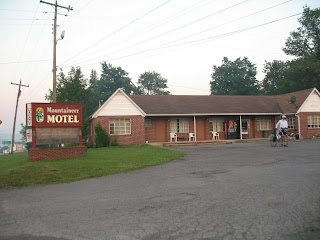


July 18. Greg hurrying to escape the Mountaineer Motel.

Motels are usually named for local people or places, if they are not chains. Usually the names are pretty dull—Alpine Thises and Vista Thats abound. But the rule has its exceptions. In Vale OR we almost stayed in the Bates Motel, but chose the Golden Wheel, instead, perhaps because we didn’t want to feel queasy in the shower or to be surprised by Mama. In Corydon IA we couldn’t pass up a chance to stay at the Nodyroc Motel and be amused by the only backwards name we saw on the whole trip.

Most of our motels were middling sorts of places. Econo Lodges, Travelodges, a Motel 6, America’s Best Value, figured among the chains. We also had some nice nights in small family motels. Tourist cabins, probably built in the Thirties, were our lodging for a couple of nights, and a resort was our destination on one. We took pretty much what came our way; I’d guess that we had a choice on a little more than half the 44 nights we stayed in motels. Limited choice meant we were extremely vulnerable to market pressures, as we like to put it these days. Examples of market pressures: the two motels in Glenn’s Ferry ID which were filled up with railroad workers; the motel in Shoshoni WY booked solid for five months by road construction workers; the dozens of erstwhile small town motels which had been turned into low-rent apartment houses because the motel trade had migrated to the interstates; the scores of relics tumbling down in weed patches, their signs obliterated by a decade of neglect. The truth is, we were often glad for what came our way, even if it was a Mountaineer. It just may be that we are the last long-distance cyclists to motel our way across the country. As the small town motel fades into the past, bike tourists in years to come will face too many days that are just too long or ride the interstates. It will be front panniers all ‘round! Everybody camps!

Motorcycles. (see Hazards, road.)

Mountains. This space is reserved for a special mountain. The great ranges—the Cascades, Rockies, Appalachians—have had their due in other entries. This one’s for Laramie Peak, a.k.a., THE LAST MOUNTAIN IN THE WEST. It’s a low, long-shouldered mountain, and it was in sight for two days as we neared the Wyoming-Nebraska border. After that it was just rolling hills and prairie until we got to West Virginia—which was a long way to go without mountains.
N


NBA Finals. On the 5th of June, our third night on the road, the NBA Finals, pitting the Los Angeles Lakers and the Boston Celtics, began. It was daring of us to start the trip before finishing the season, but we were both full of hope that we’d spend our long evenings watching the games. Both Greg and I are fans of pro basketball, especially the pre-Shaq, pell-mell style of the Phoenix Suns. But the Suns had set and we were reconciled to a match-up that featured classic rivals of bygone years. We anticipated the fun we’d have, recollecting the glory days of Magic and Larry, Kevin McHale and James Worthy, Kareem and The Chief. My journal entry for the night of the first game was “NBA finals tonight. Adam is jealous.” Adam, our son-in-law, lives out in the Oregon boonies with Beth and two children, but without TV. Unhappily, he loves basketball. After that first night, it was all downhill for us. On the night of the second game we were TVless in the Unity Motel. We did watch the first part of the game on the TV in the bar-café where we ate, but it closes when the last customer leaves and, when all the other customers left, we didn’t want to keep the owner/barmaid up past her bedtime. I fell asleep during the first half of the third game, but managed to stay awake almost through the halftime break of the fourth game. On Friday the 13th of June I wrote in my journal, I I don’t feel I’ve done the NBA finals justice. I fell asleep again last night in the 4th quarter when the game was tied. Next morning, I had to ask Greg who won, even though he appeared to be sound asleep during the whole game. He game me the outcome, including his estimate of the score. He said he wasn’t awake, though; he just hears in his sleep. We were in Victor ID, a pretty remote venue, for the fifth game. We did watch it, or made a good faith attempt, on a grainy, snowy TV. Tipoff for the sixth game saw us in Dubois WY. We had arrived a little late in the afternoon, but I tended to my knitting, got my chores done, and was ready for the game. My last journal entry for that day was, Ate as soon as we got in, at 5:30, called Mary, washed shorts, and am ready to settle into Game 6. I guess I settled pretty well, because that last game in the series, in which Boston hung LA out to dry, caught me in slumberland again. So much for the post-season. From now on it’s one sport at a time; biking and TV basketball are not a good coupling.
O

Oceans. “From sea to shining sea”—the origin and terminus of our cross-country trip. Thinking about it, the seashores presented no problem; we worried about the mountains. In fact, the mountains were much easier than the seashore. At least we found them. Protocol required that we dip our rear wheels in the Pacific at the start and our front wheels in the Atlantic at the end. So, on June 2, we pulled into Florence OR for the initial wheel-dipping. We arrived at twilight, in the rain, having only a general and hazy view of the town’s layout in relation to the ocean. But, we figured, how hard can it be to find the ocean? We discovered it’s not only hard; it’s impossible. We drove around in the dark trying to cross the dunes to the sea. Finally, we gave up and located a boat ramp in the downtown harbor. The ramp goes down to the Siuslaw River, which, technically, is the Pacific because it’s a tidal river. It remained for us to be sure that the tide was in at the dipping. That event occurred early the next morning in the gloom and rain that would be our medium for the next three-and-a-half days. The tide was in. Greg, an ultra-traditionalist when it comes to dipping, was probably a little disappointed, but I felt the baptism was good enough to get us on our way. We never suspected that it would be even more difficult to get to the ocean at the end of our journey. We had set Cape Henry as our goal, mostly because Henry was Greg’s grandfather’s name. So filial piety vastly reinforced Greg’s inclination to the traditional dip. Nothing would do but that we get to Cape Henry and do it. Otherwise, we might have just dunked our front wheels in the Chesapeake Bay (tidal waters, of course) at Hampton VA. But it was so hard to get across the bay via the Hampton Bridge and Tunnel that the dipping turned out to be seriously anti-climactic. (see Virginia.) We learned a good lesson for our beleaguered times: nothing, not even an ocean, is big enough to take for granted.
P

Pancakes and pizzas. I had this idea that we’d be eating pancakes every morning and pizzas every noon and that the totals of each would be among the most unusual and impressive statistics of the trip, perhaps enough to enshrine me in the Guinness Book of Records. It didn’t happen. Astonishingly, I downed only 32 pancakes in fifty days. It’s noteworthy that pancakes seem to be a western breakfast; I ate only six cakes east of the Missouri River. Though the numbers are not spectacular, some of the individual hotcakes were. On the second morning, at Steve’s Restaurant in Springfield OR, I had an absolutely unprecedented breakfast, two pancakes which were so large I couldn’t finish them. Wonder of wonders, two mornings later in Dayville OR, I again got two huge pancakes too big to finish. Self-doubt crept into a soul proud of always leaving a clean plate. Then, in Dubois WY, I ordered two pancakes which were advertised as “plate-size.” What they didn’t say is that the plates were platter-size. Happily, I redeemed my earlier sub-par performances and downed both of them.
We had pizza only twelve times, a surprisingly small number considering its availability in convenience stores, and how highly we prized it as a source of carbs. The most memorable pizzas were in Sisters OR, where we were so hungry after climbing over the Santiam Pass that any food would have been worthy of note. We really hit our stride at the all-you-can-eat buffet lunches at Pizza Hut. I think it was at Gering NE that we arrived at the local Pizza Hut at 1:25 p.m., just five minutes before the buffet closed. The waitress advised us to take all we wanted at once because the food would disappear in a few minutes. By the time I’d finished taking what looked good, I had a plate stacked six inches high with slices of pizza and was seriously doubting my ability to down them all. I told Greg I was relieved that we had no camera to record the pile of pizza. Several minutes later, he got me to turn my head on a ruse and snapped a photo of me and my disgracefully laden plate. The good boy in me prevailed, however, and I left my plate as clean as it was when I got it. Nobody took a picture of that, though.

Paradise Lost. The ride from Boise ID to Bliss ID took us, on the advice of a local biker, down a back road to Glenn’s Ferry and thence, said the biker, to Bliss. We got to Glenn’s Ferry with no problem, then headed down the road to our day’s destination. After a few miles we turned on to Paradise Valley Road which took us down a steep hill into a beautiful valley surrounded by gorgeous, sparsely-treed hills. The sun was shining brightly, the wind was at our backs, and we felt we were truly in Paradise. But, the further we went through the valley, the less sure we were that we would find our way to Bliss in Paradise. We found two Latino workers who told us that we had to go back to the interstate to get to Bliss. They pointed to the road which led us up a steep hill into the teeth of our erstwhile tailwind. A hard slog. When we breasted the hill we could see that the exit to get onto the interstate was nearly back by Glenn’s Ferry. Bummer. Our alternative was to climb the barbed wire fence and walk a hundred yards to the highway. I doubted my ability to lift my fully-loaded bike and worried a little bit about climbing the fence. But it seemed the right thing to do. I clambered over the fence and Greg passed the bikes to me. It was illegal, of course, our first infraction of the trip, but far preferable to returning nearly to our starting point.

Pedal strokes. You might wonder what a philosophically-inclined biker thinks about during those long days on the road. How about “How many pedal strokes does it take to get across the country.” For several days, at boring or difficult moments, I figured out the answer. It takes about 2 ½ million of them. I arrived at that figure by counting strokes per mile a number of times, on various terrains, and averaging the sums. This took quite a long while; my mind would wander during a mile-count, or I would forget whether I was counting in the two-hundreds or three-hundreds, or some situation would arise on the road—a cluster of traffic or one of those damnably loud Harleys—that claimed my attention. But a half-dozen uninterrupted iterations convinced me that 760 pedal strokes per mile was a realistic average for a long haul. The range was from 0/mile, coasting down long hills, to about 4000/mile, on long, steep upgrades. In the end, I thought it was pretty interesting, having never imagined that I could do 2,500,000 of anything.
Q

Questions. On a long ride, you get the same questions over and over again. “Where are you going?” To Virginia Beach, we’d say brightly, then wait for some sign of recognition as they did a geography check in there minds—any Virginia Beaches in Idaho (Nebraska, Iowa, Illinois, Indiana, etc.)? “How long will it take you?” Most had no idea; one person in Oregon even guessed six months, which drew a light groan from Greg. Early on, we learned to answer a couple of months. It seemed a reasonable estimate. By the last couple of weeks we knew it would be somewhat less, about seven weeks. “Where did you start?” Florence OR was a good answer. No matter where we said it, in Oregon or West Virginia, it seemd a long ways away to our companions. “Where are you from?” “Green Valley, Arizona,” generally caused some confusion. We usually tried to explain how we’d traveled from Arizona to Oregon because we wanted to ride COAST-to coast. People accepted the coastal imperative with surprising equanimity. “How many miles you ride a day?” When we answered, they’d usually look down at our legs, figuring, I suppose, that the calves might be truer than the tongue. In general, people have no idea how long it takes to get somewhere at ten miles per hour, or that a bicycle doesn’t go as fast as a car. Time and mileage estimates are always suspect. When people asked ‘How’re you going to get home?” they were most eager to know whether we were going to bicycle there. We assured them we weren’t (see Return trip). The closer we got to the end of the trip, the more interesting the questions became. “Are you…umm…partners?” was one of them.

Wednesday, March 25, 2009

Cross-country bike ride (cont.)


R


Rain. Until around mid-June, when you say “Oregon” you say “rain.” We started on June 3. The math is easy. It rained most of the day into Eugene OR from the time we started in Florence, giving us a soggy initiation. The second day, we cycled through light rain and a little snow. On the third day, we had occasional showers. On the fourth day, we had a sprinkle or two of rain and snow. From that day on—over a distance of nearly 3,000 miles—rain fell on us for exactly an hour-and-a-half. Near the Wyoming-Nebraska border, just as we lost sight of Laramie Peak in the western distance, a thunderstorm broke. We covered up as best we could and raced for the little town of Lingle, and sheltered for the duration in a city park gazebo. The storm lasted about a half-hour, exciting, but brief. About two weeks later, as Greg and I were riding towards our rendezvous after the Fourth of July break, it rained lightly for about an hour. For the rest of the time, we missed the rain. In Boise, for example, we woke to rain but, by the time we’d breakfasted (on nary a pancake that day) and were on the road, the rain had quit. It rained half a dozen times during the night, but was done by morning. We met Greg’s brother, Jim, and his family for lunch in Lebanon OH, and while we were dining convivially inside, the lightning and thunder crashed and rain fell in sheets. By the time we made our farewells, the storm was over. It was amazing to us how we missed all the rain, but we were glad for it. Riding in the wet tends to pall after a bit, even though we whistle among the drops and tell ourselves it’s “liquid sunshine,” after the Northwest manner of speaking. But we are desert rats after all is said and done. Make our sunshine dry.

Rest days. Through the planning stages and all the way across Oregon, I figured we’d be resting one day out of every week. All the big tours I’d looked into build about five rest days into their cross-country schedule. As we got into Idaho, and Mary kept asking when we were going to take a day off, it became evident that Greg and I had contrary views on the subject. I have to admit, though, that his was based on long-haul experience and mine was mere supposition. By the time we’d ridden two weeks it got to be a joke; Greg would give me a rest day only when I’d shed a bucket of blood. However, after two long, grueling days of riding against the wind for a hundred miles a day, we took an extra day in Casper, just about three weeks after we set out from the Pacific coast. We didn’t take another rest until the Fourth of July break, about two weeks later. We put the time around the 4th of July into the schedule. We estimated that we’d be in Illinois at that time, so Greg arranged several days in Peoria IL while I set up a visit with friends in Springfield. We parted in Keosaqua IA, Greg angling north to the star-crossed crossing at Burlington, I pedaling southeast to Keokuk and Hamilton. I stayed overnight on the Fourth with Mary Sue in Hamilton, going with her and friends to the Keokuk American Legion for catfish, a favorite family watering hole. The next morning I set off for the 105-mile ride to Pleasant Plains IL, outside Springfield, where I’d stay with Barb and Charlie until the 8th of July. Charlie and I had a great time visiting the impressive new Lincoln Library, tooling around Springfield to see our house on S. MacArthur and to ooh and ahh at all the development at the university since I left in 1996. It is a vastly different place now. But for all that I did see a surprising number of people I knew—a few more than a dozen, I think. The main event of the Fourth of July break for me was the pot luck dinner Charlie and Barb put on at their house for about a dozen old friends and colleagues: Carl and Roberta, Leroy and Johnetta, Dottie and Dave, Andrea and Lynn, Bob and Liz, and Lamar. It was fun to see them all again and to stuff myself with the delights they brought to our table. We look forward to seeing them soon in the desert. Greg fared similarly, but with his wife, Rhonda, at his side. She works for a Peoria insurance company, and had returned to that city from Green Valley for a week in the main office. She goes back to Peoria frequently enough that she could arrange her work there to coincide with Greg’s presence. After eating steaks from the grills of friends and family for a couple of days, he rode about sixty miles south to Williamsville to his brother-in-law’s place for the final night of our break. On the morning of the 8th we rode through the rain to meet at Dawson. My friend, Lynn, met me in Sherman IL and rode with us to a Buffalo café for a “breakfast supplement.” From that morning on we rode for two weeks without a break all the way to Cape Henry.

Return trip. More often than not, when people asked us if we were going to bicycle back to Arizona, they were making a joke. As we got closer to the end of the line, the humor wore out of that joke. We never, ever, thought of biking home. From the beginning both of us had planned to fly Southwest back from Raleigh-Durham to Tucson. In Fredericksburg VA we were close enough to the end that we could figure dates, so I made my flight reservation for July 28. My brother, Rich, picked me up at the Ocean Front Public Library (see Virginia) and we drove back to his home in Clarksville, near the North Carolina border, for six days of sightseeing amongst the wonders of the area—chiefly “Pauper’s Knob,” Rich’s farm, about seven miles from town. I also called bike shops in the Raleigh to check on having my bike boxed up for the flight back and was shocked to discover that they wanted three days and $100 to do the job. Demurring, I took the big cardboard boxes Rich offered and cut them up to tape together a bike box. It worked pretty well, though the tape it took to make the box weighed almost as much as the bike. I also needed a big duffle bag to check through the rest of my gear, but there was no place in Clarksville that sold such things. Rich to the rescue again: I took one of the burlap gunny sacks he had lying around. It was just the right size and, when I hemmed up the top and threaded a rope through, it closed in just the right way, as well. Southwest had informed me accurately about the cost of shipping my bike ($50), so I was not stunned at the check-in desk. The clerk took my home-made bike box without comment, but balked at the gunny sack. “The charge for non-traditional baggage is $15,” she said glancing sidewise at the sack with a slight curl on her lip. “What for?” I responded. “This baggage is as traditional as it gets.” She could not be persuaded to my point of view, so I forked over a ten and a five feeling that I was financing a Corrupt System. I think I probably got $30 worth of righteous indignation out of the transaction, which proved only that poetic justice was on my side. The trip home was uneventful. I had a four-hour layover in Baltimore, which was something of a revelation. I used to enjoy layovers. They gave me time to lounge around and watch people moving through airports. Since 9-11, though, it’s all changed. The places they put chairs now are away from the main concourses, off in little nooks where the traffic is slight and, usually, off in a direction that makes your neck ache when you look too long. Also, the din of cell-phone chatter makes the people-watching ambience much less pleasant than it was in the days when sensory overload came from the too-strong smell of fresh buttered popcorn. Not so much fun anymore.
When I got the bike box back in Tucson, I saw it had been opened by Homeland Security. I guess the x-ray image of all those pipes and wires must have been too much to resist. But the bike was OK, except for a slightly bent rear wheel, and an excessive amount of bright yellow Homeland Security tape. I don’t think they deigned to look at my “non-traditional” burlap luggage. Living down near the Mexican border, I am aware of the work of Homeland Security –mostly political image-making, it seems to me—and don’t find much to recommend that department of government. They do have great tape, though; it sticks well and apparently there is a lot of it. Greg had pretty much the same experience a day later.

Rivers. It seems strange that rivers hold a powerful attraction for one who is blasé about oceans. Maybe it’s because I grew up by The Father of Waters; maybe it’s because water is so scarce where I’ve lived for the past dozen years. But it is true. When we coursed along a river, or crossed one, my eye, mind, and heart were livelier somehow. And what a litany of life and legend their names sing: Siuslaw, Mackenzie, Crooked, Ochoco, John Day, Willow, Snake, Boise, Wind, North Platte, Platte, Big Blue, Missouri, West and East Nishnabotnas, Nodaways, Fox, Des Moines, Mississippi, LaMoine, Illinois, Sangamon, Wabash, White, Miami, Scioto, Hocking, Ohio, Cheat, Potomac, James. Some of these streams have personal associations: Each time I’ve traveled along the Crooked River near Prineville OR I’ve seen a Tricolored Blackbird. I’ll always associate the Wind River in Wyoming with the last time I backpacked. The White River I remember for what a dump it was as it wound through Indianapolis (it looked a lot better this time, I’m happy to report). The Potomac, well downstream from where we crossed in July, holds many memories of my time in Washington D.C. back in the Sixties. Those little waterways in western Iowa, the Nishnabotnas, the Nodaways, the Waubonsie, are names I grew up with, reading them in the newspapers every spring when they flooded. And, of course, all those middle rivers, from the Fox, in Iowa, to the Sangamon, in Illinois, are home waters. Others have public associations; the Snake with Lewis and Clark; the Ohio with the history of industry in America; the Wabash with the songs. Salman Rushdie wrote a book about a sea of stories in which the various currents are genres. Imagine the book of river stories, each tributary lending its characters and plots to the grand story of stories that is the Mississippi. Mark Twain had a good sense of that flow. Growing up by the Mississippi, I did, too, although the perspective of youth is more from the banks, a single standpoint, than from the flow itself, that gathering, mingling, carrying through space and time. From the bank it is true to say “You can never step in the same river twice,” which is a nonsense proposition from the standpoint of the flow. It says, “Roll on! Roll on!”


2 July. The DesMoines River at just below flood stage in Keosaqua IA. A week earlier it had been over its banks. The historic Hotel Manning, where we stayed, had water lapping its doorstep. (Our digs were actually in the little low building behind the magnificent pile.)


Roads. The best road for biking is one with broad, paved shoulders and little traffic. Over the whole length of our trip we were fortunate to have so many days on roads that would make a “better”category. US 26 was a pretty good road for nearly 2 ½ states, from Oregon to Nebraska. Out west, the traffic is lighter, so two-foot shoulders, like the ones on most of US 26, suffice. We rode I-84 and I-86 in southern Idaho, except for some short portions where back roads paralleled the big highways. Interstates, contrary to common opinion, are really pretty safe. The shoulders are eight to ten feet wide, so when one rides on the right side of them there’s far more room between bikes and motor vehicles than on ordinary roads. The noise and fumes of the interstate may be irritating, but they are not life-threatening on the ride itself. The best road on the entire trip, US 50 between Parkersburg and Clarksburg WV, was just like an interstate, except for the I-something number. What it did have, though, was a lot of big blue signage: “Robert C. Byrd Appalachian Highway System.” These appeared every few miles. Most politicians are lucky to get a street named after them, let alone a system of highways. Until his recent fits of truthtelling on the Iraq war, I have spent my entire political life despising Robert C. Byrd and what he stood for. But he is not “The King of Pork” for nothing, and his Appalachian Highway System is a thing of beauty. There is no grade steeper than 5%, which is achievable in West Virginia only by chopping the tops off mountains and filling up the valleys with them, a method the highway department probably learned from the big coal companies. Let me take my hat off to the august Senator for the chutzpah of his “system.” Having said that, I do wonder how extensive the system is. Does it appear anyplace else in Appalachia other than that fifty-mile stretch between Parkersburg and Clarksburg? And, for the record also, let me say that Senator Byrd’s name appears no place on US 50 east of Clarksburg, the worst road we encountered on the whole trip, worse even than highways under construction, because it is so dangerous. The section of US 50 from Clarksburg to Romney WV winds over the highest ridges of the


16 July. The Robert C. Byrd Appalachian Highway System. Just look at those shoulders!


Appalachians. It is narrow. It is in bad repair, full of holes, big cracks, and slumping at the edges from the weight of countless gravel, coal, and timber trucks. It has no shoulder and, at some places, there is a drop-off at the edge of the “pavement” eight to twelve inches deep—ditches worn by cars and trucks that have gone off the right edge because the road is so narrow. It was dangerous (see Close calls ) and scary, but beautiful, too, if one had a moment and the courage to look. We saw mountain azaleas in bloom on that stretch of road, and appreciated the shade of ancient trees as we climbed in the fierce heat and humidity. But I was glad when we put that road behind us. The second worst road was IA 2, which goes in a nearly straight line all the way across the southern edge of the state. I remembered it as a pretty good road from driving it, and Greg had crossed the state on it several years ago when he biked from Green Valley to Peoria IL. But within two miles after we crossed the Missouri River from Nebraska, I, as a native Iowan, felt the need to apologize to Greg for the condition of road. It is an old highway, mostly concrete, with gravel shoulders. Now gravel shoulders are never good, but Iowa apparently keeps its gravel loose. If a couple of trucks meet on the road alongside you, you have to get off the road into the gravel. Narrow tires can do weird things under such conditions, the worst is when they turn leftwards and throw you back into the lane of traffic. So we had to be super cautious. Unfortunately, the recent flooding had closed some of the bridges on US 34, a route which parallels IA 2 about forty miles north, so a lot of traffic shunted down to our road. Many of the old concrete stretches of the highway were in bad condition, as well. Great V-shaped hunks of concrete had broken off the edge, and there were lots of cracks, holes, and bad patch jobs. The directors of RAGBRAI (the annual Great Bicycle Race Across Iowa) selected IA 2 as the route for their big ride—for 15,000 cyclists—about five years ago. They should be brought up on charges of criminal negligence, if there is any justice at all. Certainly my feelings of attachment to my native place are looser for having to grudgingly tolerate that roadway all the way across the state.
In general, the western roads were better than the eastern. They are clean; most of them have paved shoulders; there is less traffic on them, as you’d expect from looking at our route. Nebraska’s roads were the best of all. US 26 and US 30 were both good, with the sole exception of some shoulders being worked on in “them hills around Lewellen.” East of the Missouri, however, the decay of infrastructure is evident. Perhaps the new administration will turn that around. And perhaps pigs will fly.

Roofs. Greg was our traveling expert on mechanical matters. But I was the roof guru. Not any roof, though. My reigning passion is for composition shingles, usually buffy-gray in color, and interlocking, that were sold at the beginning of the Twentieth Century. It’s not often you see a roof of that vintage unless it’s tile or slate. But those old shingles last. They lasted so well, in fact, that they ceased to be manufactured after the First World War. I first noticed them thirty years ago in Basco IL, a little crossroads village about ten miles from Keokuk. Since then, I’ve seen them in the east and as far west as Nebraska. I noticed a few across southern Iowa, but was thrilled to discover more in my pilgrimage to Keokuk than I had ever seen there previously. At a splendidly roofed old brick house I noticed while biking around town, two young men were washing a car. I approached them and congratulated them on their vintage roof. On of the young men looked up and said it wasn’t his house; it was his uncle’s. And his uncle was just about to tear off the old roof and put on a new one. Now I am not one to stick my nose into other people’s business, but my passion moved me to advise him to tell his uncle to leave the roof alone because it would outlast the bricks. I was thrilled in some of the old eastern towns to note how many of those roofs were still around and looking good. Greenfield IN, Athens OH, Parkersburg WV, and Clarksburg WV all had quite a few examples, but the capital city for everlasting composition roofing shingles is Chillicothe OH. Like many of the older towns along our way, it’s heyday was from the late 1890s through the First World War. Recently there has been a lot of restoration work downtown and the place is starting to look spiffy. Adding to the luster of the town are its dozens, perhaps hundreds, of houses and other buildings that are roofed with my favorite shingles. If you should get there, have a look. Maybe they will give you a thrill, too.

Root beer shakes. I can’t remember ever having my rightful fifteen minutes of real fame, but I have built a small legend in the family on my passion for Dairy Queen. Mary likes to tell people how I’d stop at DQs in every small town until I became a family man, at which time I got on the nearest interstate and drove like a maniac to our destination, just as everybody else does. There is some truth in the legend, though, particularly for summertime travel. Summer is the time for root beer shakes. There is just no confection as satisfying on a hot day as a DQ root beer shake. Try one. Don’t be put off if the counter person looks blank when you order. Many of them have never heard of root beer shakes. You might be asked if you want a root beer freeze. Say yes. Sometimes, if you order a root beer milk shake, they will put in both root beer and milk, which will dilute the root beer flavor and make the shake runny. A freeze is just the soft ice cream with root beer mixed up in it. That’s what you want. I love them. Mary and Ben came close to accusing me of riding across the country just so I could stop at all the Dairy Queens along the way. It was a temptation, I’ll admit. But, as a matter of fact, I had just four root beer shakes on the whole trip. That’s just one every 800+ miles, a sorry record. Moreover, one of them wasn’t even root beer. In Parkersburg WV the local franchise committed to a Mr. Pibb distributor. So, at their urging, I tried a Mr. Pibb shake. Don’t waste your time. It tasted like funky soda pop and was not at all refreshing.


1 July. The Dairy Queen in Leon IA; I recommend it.


Route. People sometimes wondered how we chose the route we took across the country, as though we made a single choice among several options. Here’s a multiple-choice question for you.
Craig and Greg took their route because
a. They chose Florence OR as their point of departure.
b. They wanted to finish at Cape Henry (Virginia Beach) VA.
c. They made assumptions about how to get across the Appalachians.
d. They relied on information gathered during the ride.
e. They had little choice once they started down the road.
f. They played it as it lay and decided on their routes crossroad by crossroad.
g. They picked roads on which motels could be found about a day apart.
h. All of the above.
If you chose “h,” you may pin a gold star to your tunic. Picking Florence rather than Astoria as our jumping off place committed us to crossing the High Cascades at McKenzie or Santiam Pass. Once we arrived at Sisters OR it was easy to choose US 26 across Oregon and most of Idaho because motels on the only other option, US 20, were too far apart. That’s also the reason we took I-84/I-86 from Boise to Pocatello: other possible routes lacked lodgings at appropriate intervals. Probably the most significant choice we made about Idaho (apart from leaving the interstate to ride to Paradise!) was to leave US 26 at Swan Valley, east of Idaho Falls, and pedal to Jackson WY via Victor ID and the Teton Pass. (see Climbs). We thought that way would be shorter and more scenic. It was certainly that, but it was also much steeper and, from Victor to Jackson, clotted with traffic. Later I learned that most of the cross-country bike tours plying US 26 continue on that road to Jackson. It follows the relatively flat valley of the Snake rather than aiming straight at the heights. Nonetheless, we have no regrets. The Teton Pass road was dramatic, challenging, and beautiful. A good example of a decision governed by motel availability was when we chose to bypass Riverton WY and take WY 133-134 to Shoshoni so that we’d have a more manageable distance to our next possible motel stop, Casper. Shoshoni was a world of anxiety for us because we nearly had to sleep outside in the cold (see Motels), but it was closer to Casper by a couple of hours. The ride to Casper turned out to be so grueling that we took our first rest day there. We chose to enter Nebraska via Torrington and US 26 rather than by way of Lusk and US 20 again because of the way motels were spaced. Once in Nebraska, it was a no-brainer to stay on US 26 and, after Ogalalla, US 30, because the towns were spaced comfortably apart and were replete with tourist services since they were all so close to I-80. From Seward NE we turned south to Lincoln and NE 2 in order to connect with IA 2 which runs straight across Iowa’s southern tier of counties. After Iowa and our Fourth of July break, it was an easy call to pick US 36/US 40 for crossing Illinois and Indiana—they are straight as a string and, again, familiar to both of us. We figured our way from Eaton OH diagonally through Germantown, Lebanon, Wilmington and Greenfield so that we could arrive in Chillicothe. That destination was predicated on our choice of US 50 to take us across the Appalachians. We labored for a while on that one. Greg called bike shops on that highway in West Virginia and Virginia to ask about it. Some thought US 50 was unsafe; others thought it was safe because bicyclists rode it frequently. A draw. We finally chose US 50 because the options were small roads of uncertain character that wound God knows where through the mountains. Adventure Cycling, a touring organization, sells a set of maps of its preferred route across the country, but they weren’t very helpful in the East because their roads didn’t go to Cape Henry. So US 50 seemed the logical choice for us. It was, after all, a federal highway and a major route across the mountains, so how bad could it be? (see Roads) US 50 took us across West Virginia to about 20 miles east of Winchester VA. The rest of the route, necessarily a diagonal from Winchester to Virginia Beach, was so distant and unknowable to us trying to decide in Green Valley that we left it to be decided day by day on the basis of local knowledge. See Misinformation and Virginia for an account of how local knowledge impacted rational decision-making! But the roads we chose did finally take us to Virginia Beach and Cape Henry as well as offering us lots of adventures and opportunities for second-guessing. How would we go from coast to coast if we were to do it again, you ask? Well, it would depend on where we chose to start and finish, etc.


Even in a country you know by heart
It’s hard to go the same way twice.
The life of the going changes.
The chances change and make a new way.
Any tree or stone or bird
can be the God of a new direction. The
natural connection is to make intent
of accident. To get back before dark
is the art of going.


Wendell Berry, “Travelling at Home”


S

Signs. I expected to see lots of funny signs along the way. I am now astonished that I only collected two. Whether I became inured to signage early on, or whether I was simply distracted by other adventures, beauty, tedium, or whatever, I cannot say. In any case, here are two. On I-86, between Boise and Bliss ID, we saw this sign: ADOPT A HIGHWAY / LITTER CONTROL / INMATES OF S. IDAHO CORRECTIONAL FACILITY. The image of felonious inmates sitting around worrying about misdemeanor civil violations on the highway was amusing—a cons-with-hearts-of-gold sort of thing. The other notable, possibly life-altering, sign we saw was on the first night of our trip, on an adults-only club in Springfield OR: SILENCE IS GOLDEN BUT DUCT TAPE IS SILVER. Brecht might have penned such a title!

Snow. It was a wet Spring all over the country and record snowpacks were recorded at some places in the West. We started in the first week of June, which meant that it was still cold and wet. We’d intended to cross the High Cascades at the McKenzie Pass on the way to Sisters OR, but the road was still closed. People told us there was still eighteen feet of snow on the roadway and lots of fallen trees. The road wasn’t expected to open until August. So we climbed over the Santiam Pass instead. And we did it in falling snow. We also biked through a brief snow squall at the Ochoco Pass east of Prineville OR. Snow did not actually fall on us as we passed over the Tetons and the Rockies, but the highways cut through vast and picturesque snowfields. The only restroom we saw climbing up to the Teton Pass was still half-buried in the snow, and though we rode on a warm, sunny day over Togwotee Pass in the Wyoming Rockies, we were amazed that the meadows along the road were covered in several feet of snow. All that snow in the West presaged the flooding we’d see in the Midwest. By the time we crossed the Mississippi, however, it was all about summer heat and humidity in which even the thought of snow quickly melted away.

17 June. Lots of snow at Togwotee Pass WY. I supposeI could have perished there!
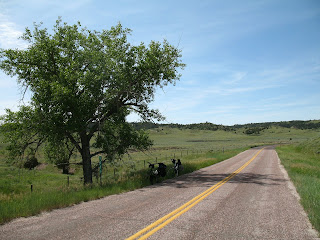
Spectacular day, Most. Several people asked us what was our best moment of the trip. It is hard to know exactly what they meant to ask, but I always took the easy way out and spoke of spectacular scenery. On the 17th of June we biked north out of Jackson (Hole) WY on a road which paralleled the Teton range. For thirty miles we looked only to our left, transfixed by the spectacular, snowy, picture-postcard mountains. When we turned east at Moran Junction, the same mountains were in view behind us for twenty more miles. For five hours we pedaled with arguably the most splendid mountain scenery in the lower 48. It is hard to imagine a more spectacular day. However, I must admit there were moments I liked even better. I loved it when we were able to leave the heavily traveled roads and ride the country byways. The road to Paradise was memorable, and not just for the name. Perhaps best of all was the little back road between Douglas and Torrington WY on a beautiful, sunny Sunday morning. We even picnicked undisturbed under a shady cottonwood in

22 June. Our spectacular picnic spot.

its westbound lane. Another memorable byway was between Bloomfield and Keosaqua IA. Its pastoral tranquility was marred only by an extended clan of hyper-aggressive Jack Russellesque dogs (see Dogs). A lot of what makes a good moment or day is contextual. Back roads are more attractive when you’ve just been on an interstate for a while. The contours of eastern Indiana were more refreshing for just having traversed the pool-table flatness of west-central Illinois. Likewise, a cool breeze in West Virginia and Virginia would have perked us up remarkably…had there been one.

Speed. If you don’t ride a bike much, it is hard to imagine how far an ordinary person can go in a day, and how fast. Most folks are nearly felled by the thought of riding seventy miles on a bike. Yet a lot of them would say things such as, “Yep. The next motel’s up at Smallville. That’s about forty mile; take you about an hour.” Yep, indeed. We seldom traveled that fast and, when we did, it was never for more than a minute or so. Forty miles per hour is really fast for normal riders, though racers in the Tour de France are said to go screaming down Alps or Pyrenees at a 65 mph clip. The fastest I have ever cycled—down from the top of Madera Canyon with a wicked tailwind—was 47.5 mph (and a fear factor of just about 100!). On the trip my highest speed was 44.5 mph down a short, but steep, hill into Paradise Valley ID. My slowest pace was 2.5 mph going up Teton Pass and a few other similar grades. That is really slow; at just under 2.0 mph I lose my balance and fall over! We averaged just about 10.8 mph per day for the whole trip. On the one day when that average was my actual average daily speed—July 17th, on the road from Wilmington OH to Chillicothe—my speed ranged from 3.5 to 40.0 mph. You can guess which figure is for an uphill and which is for a down!

Saturday, March 21, 2009

Cross-country bike trip (cont.)


T


Friday the 13th of June. On I-84 E. of
Burley ID, I fix my first flat tire.


Tires. No, I didn’t carry a spare. I don’t even know how I might have except, maybe for wearing one over my shoulder like a bandoleer. Some bikers use tires with Kevlar beads which can be folded and stowed, but mine had normal steel wire beads which must not be bent. But, no matter; I didn’t need a spare, anyway. Biker friends have told me that some who have made the transcontinental ride themselves say it is impossible to get across the country on just two tires. I didn’t know that. Really, I expected my tires to last the whole way. Following Greg’s example, I have been riding on Vittoria Randonneur Cross tires for the past several years. I buy two sets a year, and each set lasts 5,000-6,000 miles. You can imagine how disappointed I was to find the tread on my rear tire worn through to the Kevlar reinforcing layer by the time we got to Wyoming. At Casper, 1200 miles into the trip, I rotated my tires, putting the worn back tire on the front and the new-looking front tire on the rear. I fully expected to buy a new tire somewhere in the Midwest at the rate of wear I was seeing. Of course, all the weight on the bike was over the rear tire; I had no front panniers to distribute the load. When I got to Springfield IL for our Fourth of July break, the tire I rotated to the rear in Casper still looked pretty good. But I thought it would be prudent to put a new tire there, just in case. So my host, Charlie, drove me into town to the R&M Cyclery (see Dedication) where I asked for the sturdiest they had in a 700mmX28mm size. After I turned down the popular Gatorskin tire because it was too flimsy, the clerk brought out a redoubtable Schwalbe that looked tough enough to excel in a trans-African motocross. Back at Charlie’s house, we tried to put it on. It was so thick and stiff that it took the two of us to hold the sidewalls on the rim. And, when I finally got it pumped full of air and on the bike, the big tread rubbed the frame, stopping the wheel from turning. It was too late to return the impossible Schwalbe to R&M. I put the old Vittoria back on the bike and rode off for my rendezvous with Greg. That old tire got a tad bare over the two weeks it took us to get to Cape Henry, and a little red Kevlar was showing through when we dipped our front wheels in the Atlantic. But it lasted all the way. Greg’s tires would have made it, too, but he bought a new one on the day before we finished because he had to ride an additional day to meet his brother in North Carolina (see Brothers).

We did have four flat tires on the journey, though—all on my rear tire. The first, along I-84 in Idaho, was caused by a bit of reinforcing wire from the treads that fall off truck tires (see Hazards). The second, near Casper WY was likely from the same cause. The third was mechanic’s error; I pinched the tube when I rotated the tires in Casper. The last came at then end of our grueling ride over “them hills around Lewellen” (see Climbs) to Ogalalla NE. That was it. Greg had no flats at all. In fact, he’s never had a flat tire on any of his long-distance tours. I wish I knew why.


Trains. One of the unexpected pleasures of the trip was trainwatching, especially in the West. I made the discovery as we rode past two long Union Pacific trains on a siding between Burley and Pocatello ID. There were probably more than 200 boxcars in the trains, all of them covered in graffiti. I had seen such things before, of course, but never so much so close. About 10% of the “tags” were breathtaking in their design. Most were merely conventional, and a few were so gross in their simplicity that I could actually read them—I remember an “Eric” that looked to be scrawled in a first-grader’s initial attempt at cursive. But I loved the intricate designs. I think I may have an innate weakness for them. During the year I taught in London as an exchange professor, I became almost obsessed with the Lindisfarne Gospel and the Book of Kells, two ornate manuscripts from the 7th and 8th centuries in Britain and Ireland. Each manuscript has “carpet” pages which are entirely devoted to ornate designs, much like those on Islamic prayer-rugs. The books also featured extravagantly embellished initial letters and page margins, often using stylized birds and serpents to create complex interlocking designs. Some of the best “tags” on those UP trains inspired the same awe as the two medieval manuscripts. Oddly, I know less about the modern genre than I know about medieval monastic arts.

As we rode towards the border of Wyoming and Nebraska we began to see coal trains, hundreds of them, making their way from the Wyoming coal fields to their destinations in other parts of the country. These were lo-o-ong trains. I counted cars on four of them and found they had around 135 cars each. Unlike the UP trains we saw earlier, there was a striking lack of graffiti. The attraction of the coal trains was their length and number. They would come, a few minutes apart; eastbound, they were loaded with coal; westbound, they were empty. The full ones usually had four engines pulling and one at the rear, pushing. We guessed they let the rookie engineers sit in the pushers. It was hard to believe the number of those trains and to imagine the enormous scale of the coal mines that fill them each day. Trains were bound for New Jersey, Texas, South Carolina, Florida, Illinois, Missouri—almost any state east of Wyoming you can name. The tracks paralleled our road most of the way across Nebraska. One night we stayed in North Platte, which boasts the largest rail yard in the world, used mostly for switching those coal trains. We were really a bit relieved when we turned away from the mainline and its constant din of railway engines and horns.


U


Unlawful Excursions. See Cities and Virginia.


V


Vernacular. People usually asked where we were going and where we’d come from. When we told them their reactions were occasionally entertaining. A waiter in an Athens OH Pizza Hut found that we’d started on the coast of Oregon and went into a frenzy of astonishment. “Get out!” he shouted. Then stomping five giant steps away, turned on his heel and again yelled “Get out!” Then he fell, in four crazy lurches, to the back wall, wailing “Get out!” This continued for another two or three iterations until I felt we should rise from our booth and leave. Finally he calmed down, wheedled some more information about our trip, and brought us our pizza. Most fun of all was a convenience store clerk in Newport News VA. When she discovered that we had pedaled all the way from Oregon, she jumped back and, with arms akimbo, shrieked “Don’t play with me!” I was so taken aback that I wasn’t sure I’d heard what she said, so I asked her to please repeat. She obliged—with all the gusto of her first take.

I had expected to hear many odd usages along the way, but there is really only one to report. But it so perfect an example of a Mark Twain Americanism that it alone is worth the trip. On the second day out, as we were riding in light rain from Springfield OR up the Cascades to Belknap Springs, we stopped for lunch at the Finn Rock Café, a homey little place right on the rushing McKenzie River. A fellow at the bar was eager for some conversation. A rafting guide on the McKenzie who takes tourists for a 10-mile boat ride downriver, he was temporarily unemployed because the river was running too high and fast from the snowmelt. I asked him if it wasn’t difficult to make money at that sort of outdoor work because it rains so much in Oregon. Just then a patch of blue opened in the sky above us. I commented that it looked encouraging; the clouds were breaking up and the rest of the day would be sunny and fine. Our friend laughed and pointed to the patch of blue: “We call them sucker holes,” he said. “People see them and sign up for a raft trip. They pay their money and it starts to rain again.” Now sucker holes is a highly serviceable metaphor in a consumer culture like ours. What else is “Going Out of Business!” or “Giant George Washington Birthday Sale!” or “$750-billion Exonomic Fix”? I’ll bet a day hasn’t gone by since June 4 that I haven’t thought of sucker holes.


Virginia. Of the eleven states we passed through on our way to Virginia Beach, only one gets an entry of its own. You may justly wonder why I play favorites. Virginia is my “favorite” because it is the only one to qualify as a genuine Commonwealth of Horrors. You know how hard it was for us to get out of Richmond and how we narrowly escaped arrest for our unlawful excursion on I-95 (see Cities). You were surely shocked to learn how difficult it is to get a reasonably accurate answer to any question about roads in Virginia (see Misinformation). You probably brushed away tears at the account of my “death” in Newport News from the horrible heat and humidity and rejoiced, I am certain, at my “resurrection” (see Life and Death). It remains for me to relate the events of our last day—the 46th riding day and 50th overall—so you can appreciate the solid claim Virginia has to its special recognition.

The day started well with a gourmand feast at the best motel breakfast counter of the trip. The sky was sunny and we were in a bright mood, entirely ready to end our long adventure. We had put in a lot of time the day before arranging to get across the bay from Hampton to Norfolk and Virginia Beach. We hadn’t thought it would be difficult. When we looked at Virginia’s official bike map in Green Valley, it showed the Hampton Roads Bridge and Tunnel to be a bike route. (Hampton Roads is the name of the strait that connects Chesapeake Bay with the James River.) But when Greg stopped in Newport News to buy a new tire, the bike shop owner told us that we couldn’t just ride across by ourselves. He said the state Department of Transportation (VDOT) required bikers to be carried across by a special truck that had to be expressly ordered. Greg spent hours that afternoon and evening arranging for our conveyance. He checked with the VDOT and the Highway Patrol and discovered that a private towing firm in Norfolk did all the conveying, and that we had to do all the arranging with them. So Greg did. He called and made sure we’d be picked up when we called about 7:00 a.m. when we got to the pick-up spot. Then he called the VDOT (and the Highway Patrol, too, I think) to double-check the arrangements with them. Everything was foursquare. We were to be picked up at the beginning of the Bridge and Tunnel. We were a little uneasy that the only road to that place was I-64. We knew it was generally illegal to be on the interstate, but figured this was an exception because it was an official bike route and, we were relieved to discover, the on-ramp did not have a sign prohibiting bicycles, etc. So off we went, pedaling merrily down the capacious shoulder of I-64 to meet our wrecker at the bridge. Greg was far ahead when a white VDOT truck, horn blaring and yellow lights flashing, pulled up behind me. The driver motioned me to stop, then leapt from his truck in his white coveralls and yellow hard hat, rushed to the bike and planted a red highway cone in front of me. “Stay right there!” he yelled, “The Highway Patrol is on the way!” By the time the State Police car arrived Greg had come back and was trying to explain to the VDOT official what we had done and why we thought it was OK. I think the guy was deaf. In any event, the highway patrolman became our focus. He didn’t want to hear anything from us, especially any justification concerning maps and signs and phone calls to his own agency. He was adamant: “It is illegal to ride a bike on my interstate.” (his emphasis) It was no trouble at all to choke back the response that he was just the protector of our interstate. By this time we were in our do-not-rot-in-jail mode. After a while, the officer decided that the degradation ceremony had run its course. He said he understood how we could have been misdirected; he’d got plenty of misinformation on his cross-country motorcycle rides. He also said we could get to our tow truck by riding city streets to the Mallory Exit of the interstate. He even tried to give us directions. Relieved to have avoided arrest, we pedaled off the interstate by way of the on-ramp and set about finding the Mallory Exit—which we did, after a couple of wrong turns and several conversations with local pedestrians. At the Mallory Street Exit we could see what appeared to be a maintenance yard down by the interstate. Greg figured we could call from there and that it would be a good place to meet our tow truck. We were not halfway down the ramp before an orange-clad man came racing out of a little barn, waving his arms and screaming. As we got closer we could discern his words, “Get out!” “Illegal!” After a couple of minutes he calmed down enough to listen to our story—that we were to meet our tow truck here, etc. Agent Orange said he’d been there eighteen years and he’d never seen or heard of wreckers hauling bicyclists and, moreover, if a tow truck were to haul us across it would have to be from up on Mallory Street. So, back up the hill we went to Mallory Street where we found a Hardee’s hamburger joint and began to call our rescuers from its parking lot. Greg first called the towing company we’d made the arrangements with, but the man who answered said they didn’t transport bikers anymore because of the high cost of liability insurance. Greg then called the VDOT which, at that dark moment, hadn’t the foggiest about anything. Greg then phoned the contact person the VDOT had given him the night before. The contact turned out to be a bit addled and just couldn’t grasp where we were, where we wanted to go, by what tunnel or bridge and, getting to the bottom line, admitted he couldn’t do anything about it, anyway. By this time we were drowning in a sump of dejection. It didn’t seem possible to get across the water to Cape Henry. After a minute or so of heroic attitude adjustment, we agreed that we just needed to find somebody to haul us across Hampton Roads on our own, and we decided to start by borrowing a phone book from Hardee’s. As we turned to enter the restaurant, a large man carry a fresh cup of coffee came out the door. Almost reflexively, Greg asked him if he knew anybody who could take us across. He asked where we were going and, when he heard us say Cape Henry, he allowed that he was going right there, right away, and we should just load our bikes on his truck. Our angel was John. He was a 61 year-old retired electrician now re-employed by the power company, a resident of Yorktown, a father of three grown daughters, a husband to a good wife who does not love the outdoors as much as he does but who does genealogy on her Scottish ancestors, a conservative Republican who would reluctantly vote for McCain, and, as you can infer, a friendly and loquacious companion. He had some work to do for the Army at Ft. Story, where Cape Henry is located. He said security was tough at Ft. Story so we should ride through the gates by ourselves. He wasn’t just whistling Dixie, as we discovered. We answered all the security guard’s questions, watched as he scanned our picture IDs, and signed the forms as requested. When we got on our bikes to ride the mile-and-a-half up the road to Cape Henry, the guard told Greg he couldn’t ride his bike. Why? Because he did not wear a helmet. The base commander is very insistent that bikers wear helmets, the guard said. So Greg asked if he could leave his bike at the gatehouse and walk in. Not possible, said the guard. The base commander is adamantly about enforcing the rule against leaving personal effects unattended on the base. Then Greg asked if he could move his bike twenty feet and leave it leaning against the outside of the base’s permeter fence. No rule against that, said the guard. So we set off for Cape Henry, Greg jogging shirtless down the road
July 22. We are at Cape Henry at last. But
who cares?
as I pedaled alongside. We got to Cape Henry without incident, walked out to the beach, took some pictures, and then repaired to the PX across the road for some Gatorade and souvenirs. After jogging and pedaling back to the gatehouse, we still had to find an ocean to dip our front wheels in, a ritual Greg was keen on. We found a beach access a short distance away, did the dips while a Quebecois couple snapped our pictures, and were schlepping our bikes back across the deep sand when Greg remembered he’d left his souvenirs on the shelf at the PX. So we parted company there, Greg to lean his bike against the fence and jog back to the Cape while I ventured on alone to Virginia Beach and my rendezvous with brother Rich. Greg and I exchanged vague assurances that we’d meet for lunch in downtown Virginia Beach, but, since it was a strange place to us, the arrangement lacked critical detail. Virginia Beach turned out to be like every other town in the state—full of aggressively misinformed people. I couldn’t find the street on which the Ocean Front Public Library was located. That was where Rich and I agreed to meet at 1:00 p.m. Three times I had to ask directions. The first group of locals sent me two miles south where the city obviously ended, so I pedaled back to the city center and asked another couple of locals. They sent me 3 ½ miles north to an intersection I had seen on the way into town and knew was not the one I sought. So back into town I rode. In the downtown area I stopped for a light and asked a city worker, stopped for a left turn signal, for directions to the library. He pointed to the cross street in our intersection. “That’s it,” he said. It was. A few blocks down it stood the library, not as imposing as it appeared in the photo on its website, but a welcome sight, nonetheless. The walkways and portico were clotted with homeless people, so I decided to leave my bike, with all my worldly possessions packed on it, against the wall as near to the main door as possible. There were bike racks out by the street that ran by the side of the building, but there was only one old bike in them and the setting looked too vulnerable for my comfort. So, leaving the bike in that relatively secure spot near the door, I went into the library to write some notes on their computer. After about fifteen minutes I was confronted by a security guard who asked me if it was my bike leaning against the wall of the library. It was a rhetorical question. I was the only person in the place decked out in black lycra shorts and an outlandishly loud jersey. The guard said it’s illegal to lean a bike against the building and, if I didn’t move it to the bike rack immediately, it would be towed away. “TOWED!” I cried. “They’re going to TOW my bike away?” “Well, they may not actually tow it but they will haul it away,” the guard said. Gad! I moved my bike after the guard assured me it would be safe. When Rich arrive it was still there, undisturbed.

That was Virginia—just one outrage and frustration after another. For all Greg and I know, the whole state is riddled with authoritarianism, bureaucratism, and error, with only a couple of angels for leavening. In my experience it is a Commonwealth of Horrors, my brother and his town of Clarksville excepted, of course.

(To read entries in W, X,Y, Z, and Afterword, click on "Older Posts" below.)

Wednesday, March 18, 2009


W

July 22. Virginia Beach VA.
We satisfy ritual requirement by dipping
our front wheels in the Atlantic.
Photo courtesy of some nice people from
Quebec City.


Wind. Wind trumps grade. I have never met a bicyclist who doesn’t agree that it’s easier to pump up a hill than it is to ride against the wind. I have been blown off the road by a crosswind; I have been stopped cold by a sudden gust of headwind; in fairness, I have also been blown along the road, spinning merrily in a sweet, sweet tailwind. But when we’re talking wind, it’s headwind we mean. A lot of the agony is mental. Headwinds used to make me crazy. However, several years ago, I underwent one of the premiere attitude adjustments of my life. Now I can usually accept a headwind as just another fact of the road, like pavement, grade, sunshine, or rain (see Attitude Change). I was severely tested several times on the trip, though. Leaving Shoshoni WY on our 100-mile ride to Casper, we were challenged by an east wind I estimated at 15-20 mph. I could not ride faster than 7 mph against it. Greg, who had got pretty far ahead, waited for me and suggested I draft him for a while. (“Drafting” occurs when you ride close to the rear tire of the bike in front of you, in the eddy created in the wind.) Drafting him was a good thing to do; I was able to keep up at a speed of 9.5-10mph. At 7mph, we would have been fifteen hours on the road to Casper. Luckily, the wind moderated and shifted to the side later in the afternoon. A week later, in “them hills around Lewellen” NE, I came as close as I ever have to my prior wind-borne lunacy. But we made it to Ogallala, and I have to believe I’m better for being tested. You know—“anything that doesn’t kill me only makes me stronger.” Um-hmm.
Many people think that riding west to east across the country maximizes tailwinds since they are riding in the same direction as the prevailing winds. Experts and experienced bikers know better. The prevailing winds do their prevailing at 30,000 feet of altitude. Down on the surface of the earth, landscapes significantly influence wind direction, mountains and valleys chief among them. There is a saying on the road: “If you get lost just turn into the wind.” Then you’ll be headed the right way. We thought for a while that the prevailing wind myth was a reality. For nine straight days across most of Oregon and southern Idaho we enjoyed tailwinds. We were enjoying a tailwind again as we turned east from the Tetons in Wyoming. As I mentioned above (see Cyclists, Long-distance ), just outside Dubois we met two young cyclists from upstate New York who were on the verge of abandoning their trip. The wind had been in their faces for more than a week, and after this day they had just about had it. We assured them that wind direction is not permanent and that a fair wind would rise for them before long. Unfortunately for us, it did. Not ten minutes after we left the two young men, the wind shifted. It stayed shifted for eight straight riding days, and was in our faces across the rest of Wyoming and more than half of Nebraska. It’s worth telling that story again just to highlight the cussedness of wind. But, on the whole, our experience supports the experts. Of the 35 days when the wind was a significant factor in our progress, nineteen were days with tailwind and sixteen were days with headwind. The rest of the time the breezes were negligible, no more than 5-7 mph from any direction. I should mention that the truth of the “easy East, windy West” phrase was borne out on our trip. After we crossed the Missouri River, the wind exceeded 10 mph on only one day.

Weight. A few incurable meliorists have asked me about my trip. One variation on their general query concerning how I am better for having done it is “What did you learn on your cross-country ride?” If I were to have my wits about me in the face of such a question, I’d say that I learned an awful lot about convenience stores. I do not frequent them in my normal life, but I could not have cycled from coast to coast without them. In a little over seven weeks, we must have been in a hundred convenience stores. So my experience is pretty broad. I know what they sell, and it’s all pretty appalling. Candies, chips, Twinkie-type confections, jerky are all staples. Soft drink machines dispense drinks in awesome cups—the smallest is generally 22 oz., 10 oz larger than a regular can of pop, and the largest is way too big for me to carry. If you’re ready for lunch, most places will sell you a large hot dog or corn dog or piece of pizza, and you can have your choice from a large assortment of ice cream goodies for dessert. Unsurprisingly, there are a lot of stunningly overweight people in convenient stores. I have read for years about Obese America, but life with Mary has kept the epidemic somewhat distant, even abstract. No more. It is all too evident when you hop from convenience store to convenience store across the broad midsection of America. Eastern Oregon, however, takes the cake when it comes to obesity. I don’t know what is so special about life in that hardscrabble land, but whatever it is it puts on the pounds.
Speaking of putting on pounds, I gained six on the ride while Greg lost ten. I don’t know how he did it. He ate constantly, grazing the goodies he had lined up in his handlebar bag, taking his “carb booster” at the end of each day’s ride, and eating three or four squares a day to anchor his diet. I didn’t snack much while pedaling. My handlebar bag was not suitable for service as a trough; my snacks were tucked away in my jersey pockets or the rear bags and, so, forgettable. But I always ate as heartily as he did at mealtimes and snack breaks at convenience stores along the way. He must have the metabolism of a bird. I, like most of my fellow Americans, surely don’t.


X


Xenophobia. Though I may have looked like an alien with my tight black lycra shorts, outlandish Arizona flag jersey, helmet and shades, I always felt like myself. ”Myself,” of course, is the exceedingly normal, 97% inoffensive Iowan. Most people treated me like myself and engaged easily in pleasant conversations. Some people, however, treated me like an alien, which for “myself,” is always a problem. In Brogan OR, we filled our plates at a most unusual convenience store spread (see Food) and went out to an attached carport/patio to eat. There were five or six men out there, eating and talking. Not one of them acknowledged our presence the whole time we were there. There was nothing unusual about them. They ranged in age from mid-thirties to about seventy; they were talking about local things—weather, hay crops, prices. (The youngest of them was also the most obese person we saw in eastern Oregon. His T-shirt had no prayer of covering the considerable personal property between the shirt’s bottom and the top of his unbelted pants.) I had another such experience after Greg and I parted for our separate Fourth of July breaks. I had been riding an hour or so from Keosaqua on a most pleasant back road that crossed and recrossed the DesMoines River and wound through the picturesque hills that Grant Wood painted around Bentonsport IA. I was feeling pretty good about being an Iowan after suffering some existential anxiety because of the condition of the highway we’d been riding since crossing the Missouri. I was also a little hungry and, therefore, delighted to see the little café on the other side of the bridge that crosses the DesMoines as you enter Farmington IA from the west. The apparent seating capacity of the place was 10, and all the seats were stools around the L-shaped counter. Six of the stools were occupied by older men having their breakfasts and talking. I said hello to the company and plopped down on a vacant stool. They continued talking and never once looked at me or said anything to me. I’d have thought that they’d stare a little, even if they didn’t have anything to say. I felt a little strange to “myself,” being unrecognized by my own kind! I don’t know what it is about these groups of old men. “Xenophobia” meets my alphabetic requirement, though I’m not convinced it’s a good explanation. But it’s good enough, I guess. When I imagine their response if one of their local buddies showed up looking as I did, I might think their silence was an act of kindness.


Y


Yesteryears. When I was a child, Sunday afternoon was the time for a drive over the country roads to visit relatives who lived in the small towns around Keokuk. I have early memories of motoring over what seemed an eternity on country roads to visit Aunt Nellie and Uncle Chester, who lived on a farm near Argyle. Great-uncle Prior and his family lived out by Montrose, the Welches over in “West K,” and some family related to the Browns and Welches by skeins of kinship only Aunt Flossie understood, who lived across the river (Mississippi) near Hamilton. On these drives we’d pass through little rural towns—Mooar, Powdertown, St. Francisville—and we always loved slowing down in Summitville, about five miles north of Keokuk, to view the two-story clapboarded house where my father was born during the period my grandfather was superintendendent of the County Farm across the road. In my adolescence, the inhabitants of those little towns would stream into the grocery store where I worked for their week’s provisions and, on Saturday nights, after the store closed, my buddies and I would pile in Duck’s car and we’d careen down country roads to small town square dances in our constant questing for girls. My first driving date, after I finally got my driver’s license and an uncertain claim on the family car, was to a dance at Sutter, small in size but large in legend, over in Illinois. Who I was, and who I am, is bound up with the reality of those little towns. As a result, there was an elegiac tone to our trip. We rode through more than a hundred of those little towns on our way across the country. Most of them were sad little vestiges of their former days: motels made over into cheap little apartments for the rural poor or left to subside into the weed patches and paint flakes that surrounded them; short little main streets looking more like used plywood lots than centers of local commerce. Strangely, my sense of this was less to do with disgust at sight of decay than a sort of sad wonder at my own lost childhood, a mournful twinge at that warp in time which left me disjoined from my own early life. That same feeling was with me as I toured my hometown, probably for the last time, on the Fourth of July. I suppose it is entirely appropriate for one of my years, and it certainly suits my temperament. My sentiments of mortality are not so much bleak or anxious as forlorn. So it goes.


Z


Ziggy’s. We were a little downcast when we rode into the Amber Inn in Bliss ID on the 10th of June. The restaurant across the road from the motel was shut down and boarded up. The only place to eat was the convenience store. When we wound our way down the quarter-mile drive for some supper, we were ecstatic. Not only did Ziggy’s offer the usual convenience store fare, and then some, for 24 hours a day, but there was a little restaurant at the far end which offered decent meals and great pie. Bliss, indeed! Tasty pie and alphabetic necessity require me to nominate Ziggy’s as the Premier Convenience Store we patronized on our trip. If you ever get to Bliss, make a pie stop at Ziggy’s.


AFTERWORD


Any long journey can become a pilgrimage, especially when we make it under our own power. The same movements, when they are repeated day after day and embedded in a routine that’s almost a ritual, become meditative. Consequently, there’s a contemplative, even spiritual, dimension to biking across the continent—Zen with pedals. The entries in the alphabetical account of the trip deal with many different things, but there are just a few themes that thread through them. Age is chief among them. Growing old is the most exciting thing I do these days. Having advanced to the threshold of old age, I am feeling new sensations, seeing new facets of myself and the world, discovering my thoughts turning into uncharted territories. There is no time warp when you plant your rear on a bicycle saddle; your sensations, insights and thoughts remain. Hills, wind, and, yes, even lots of convenience stores don’t change that.

Biking through all those small towns and, especially my hometown of Keokuk, was a powerful experience. The best word I could find to describe my response was “forlorn.” There is in that word a pervading sense of being lost, which is just how I felt. I think one always feels twinges of displacement as one moves from one stage of life to another. Moving into old age, we’re far more likely to experience change as loss because we’re actually falling apart. We lose physical abilities, height, and a fair measure of our mental agility. I saw on the trip that we also lose our world. The small towns I knew are no more. The places of my childhood are gone. The gutters, where we shot marbles, collected nightcrawlers and built dams after rains, pushed toy cars on their fabulous journeys, have all disappeared under the postwar glut of automobiles. Who I am at any moment is really how I am living with others in the material and natural world. In this ecological view of things, the loss of world means a loss of self. They go together. The drama of aging is largely about how we do justice to our losses—the material world and earth and self we knew. Serious stuff.

Fortunately, we are trained up to accept the loss of the world simply by living in a culture of change which puts a positive spin on loss. Buck Rogers is our prophet. Lucky, too, are those of us who mellow out with age; no need to assert our disappearing selves as much. Blessed, as well, are those who go on long bicycle trips and relearn important life lessons. Almost thirty years ago, a sojourn at Mt. Angel Abbey, in Oregon, taught me how to live more in the moment and flow of things. I was one of those people who depend on organizing people and things in projects that have a scheduled end. Monastic life showed me how people can live by the bell—when it rings they put down what they’re doing and do something else—with accomplishment and integrity. They simply live as fully as they can in the moment and give themselves to the flow of living. And that’s exactly what a long-distance bike trip is about. Virginia Beach is not just a ride to the store; it’s more like an impossible dream. So you just take it a day at a time and live in the moment, whether it’s a daunting headwind, a hot, steep climb, or a corn dog at some godforsaken little store. There’s no way to live the destination before you arrive. So enjoy the trip. Lance Armstrong had it right when he reminded us: “It’s not about the bike.”